
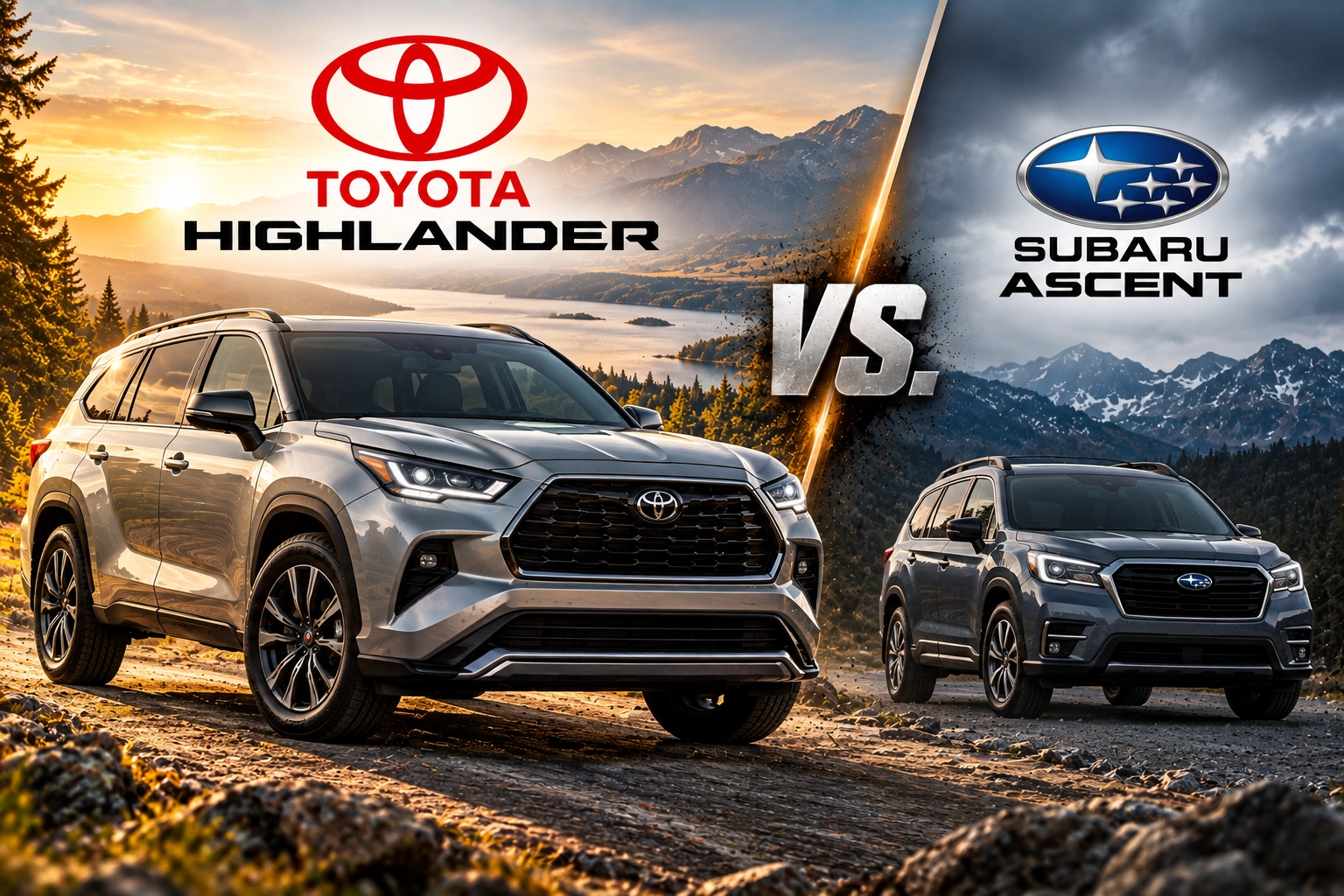
Three-row SUVs are one of the best options for growing families, and both the 2026 Subaru Ascent and the Toyota Highlander could be great vehicles for your family. Both of these vehicles have similar stats, but with subtle differences that could be important for your purchasing decision.
So in this quick guide, we'll break down the most important comparisons between them:
Subaru Ascent Toyota Highlander
Starting MSRP $40,795 $46,270
Engine 2.4L Turbocharged 2.4L Turbocharged
Horsepower 260 hp 265 hp
Torque 277 lb-ft 310 lb-ft
Seating capacity 7-8 7-8
Passenger volume 153.2 cu ft 139.5 cu ft
Cargo space 75.6 cu ft Up to 84.3 cu ft
Towing capacity 5000 lb 5000 lb
Fuel economy 19 mpg city / 26 mpg highway 24 mpg gas / 35 mpg hybrid
Drivetrain AWD with CVT transmission AWD on all models
Ground clearance 8.7 inches 8.0 inches
The 2026 Subaru Ascent features a 2.4L turbocharged SUBARU BOXER engine, with a maximum of 260 hp and 277 lb-ft of torque. Symmetrical AWD is standard on all models, as is a CVT transmission.
The 2026 Toyota Highlander offers similar specs: a 2.4L turbocharged four-cylinder engine, offering 265 hp and 310 lb-ft of torque. AWD is standard on all 2026 models. One significant difference is that, unlike the Ascent, the Highlander offers both gasoline and hybrid options. Both utilize CVT transmissions.
In short, the Highlander will be slightly better at accelerating, especially under load, and offers a slightly smoother ride. However, the two are largely comparable in terms of performance.
Again, the two vehicles are very similar in this respect. Both can seat up to 7-8 people, depending on whether the middle row is a bench or utilizing a "captain's chair" arrangement with space between the two middle seats.
The Ascent has a total of 153.2 cu ft of passenger space, versus 139.5 cu ft for the Highlander. Third-row legroom is 31.7 inches for the Ascent, and 28 inches for the Highlander.
Another major difference is that the Highlander allows you to fold down the rear row, as well as the middle row if you choose the bench. This substantially improves its cargo capacity, up to 84.3 cu ft compared to the Ascent's 75.6 cu ft.
In practical terms, the Ascent will offer more space for passengers, which is especially important if you have teens or several adults in your family. On the other hand, the Highlander gives you more flexibility in how you use the interior space and is better for hauling cargo, groceries, camping gear, and other items.
The differences are more pronounced here: unlike the Subaru Ascent, the Toyota Highlander offers a hybrid option that can substantially improve your gas mileage in most cases.
The 2026 Ascent is gasoline-only, with EPA ratings of approximately 19 mpg in the city and 26 mpg on highways. On the other hand, the Highlander can reach 35 mpg in its hybrid configuration, or around 24 mpg combined for the gas-only variants.
So if you want to minimize fuel usage, as well as reducing your impact on the environment, the hybrid Highlander is the clear winner here. Just keep in mind that the hybrid option will add around $1,750 to the price tag. Do the math to see if the extra expense makes sense, given your driving habits.
In terms of towing, both vehicles are identical: they can haul up to 5,000 lbs when properly equipped, which makes them great for towing boats, campers, moving trailers, and similar equipment. Likewise, both offer all-wheel drive for better traction and handling, even in poor weather.
The Subaru Ascent does have the edge in ground clearance, 8.7 inches versus the Highlander's 8 inches. In addition, the Ascent features Subaru's proprietary X-MODE and Hill Descent Control for better all-weather capabilities.
Remember that towing capacity depends on configuration, equipment, and internal weight. Always make plans based on real-world numbers and usage.
Both the Ascent and the Highlander feature extensive safety features, based around Subaru's EyeSight system and Toyota's Safety Sense package.
Both feature driver assistance technologies such as blind-spot monitoring, collision mitigation features, and lane departure warnings. In addition, they sport large infotainment systems with voice feedback and smartphone support to keep your eyes on the road as much as possible.
However, Toyota has the edge here because their Safety Sense system is widely recognized as best-in-class for passenger safety features. It includes additional safety features the Ascent lacks, including lane tracing assist and smart road sign recognition, giving the driver more information to ensure a safe drive.
Either vehicle will protect your family, but Toyota is tops in this respect.
To summarize, the Ascent will be a better option for buyers who want:
The Highlander is your choice if you want:
If you're in the market for a Toyota Highlander, come to one of the best car dealerships in Brockville - 1000 Islands Toyota. We offer a huge selection of both new and certified pre-owned vehicles, backed up by top-quality service whenever you visit. All of our pre-owned vehicles come with a certified CarFax report.
Contact us or just come visit the showroom to test drive a Toyota Highlander.